
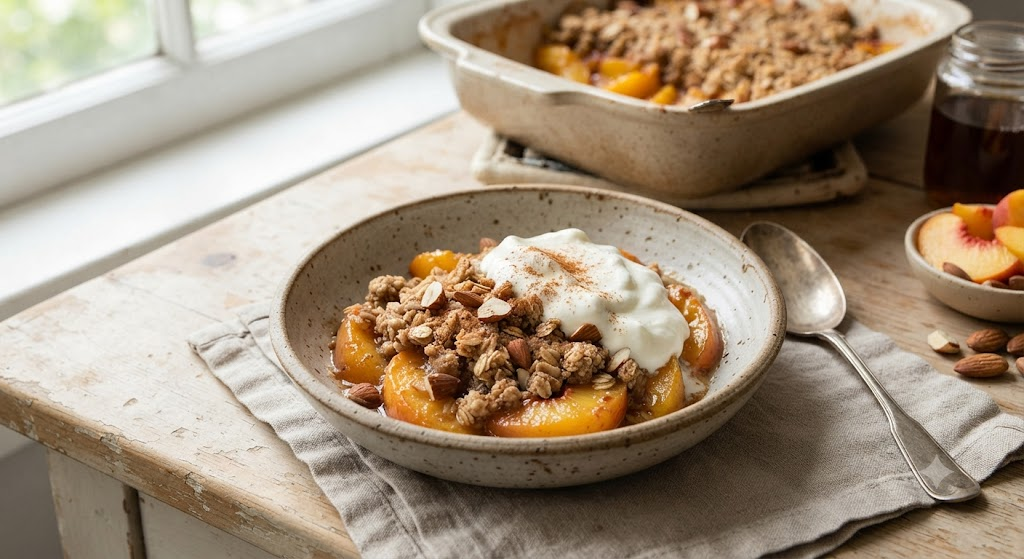
Peach crisp is one of those desserts that feels like it should be off-limits if you’re trying to eat well — buttery, sugary, and often loaded with white flour and a full stick of butter in the topping alone. But at The Healthy Plate Lab, we don’t think the answer to a craving is avoidance. It’s a smarter build.
The classic version leans on refined sugar and white flour to create that golden, crumbly topping, with little nutritional value beyond calories. Our version keeps everything you actually love about peach crisp — the warm, jammy fruit, the buttery crunch on top, the cinnamon-spiced aroma filling your kitchen — while rebuilding it with ingredients that do more for your body.
We swap white flour for a mix of oats and almond flour, which adds fiber and healthy fats instead of empty starch. We cut the added sugar significantly by leaning on the natural sweetness of ripe peaches and a touch of maple syrup, rather than piling on white sugar. And we use a modest amount of coconut oil or butter, just enough for that satisfying crumble texture, without drowning the topping in fat.
The result is a dessert with meaningfully more fiber and protein than the traditional version, a lower total sugar load, and a texture that still delivers the crisp, golden topping people expect. It’s proof that “healthy dessert” doesn’t have to mean a compromise — just a better-built version of the original.
Ingredients & Nutritional Benefits
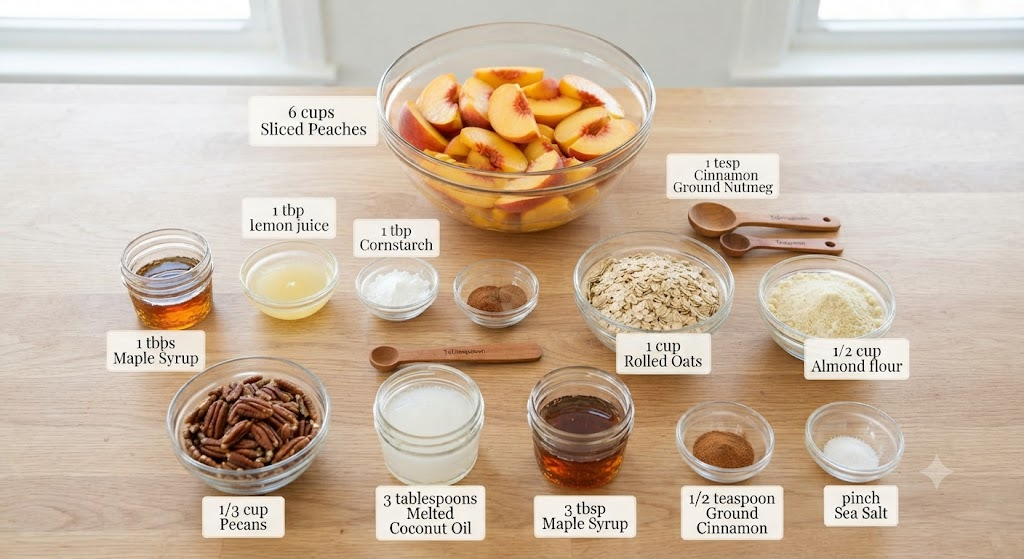
For the peach filling:
- 6 cups sliced fresh peaches (about 6–7 medium peaches) — Naturally sweet and packed with fiber, vitamin C, and vitamin A. Using ripe, in-season peaches means you need far less added sugar to get a flavorful filling.
- 1 tablespoon maple syrup — A natural sweetener that adds warmth and depth without the sharp sweetness of refined sugar.
- 1 tablespoon lemon juice — Balances the sweetness and helps prevent the peaches from browning.
- 1 tablespoon cornstarch or arrowroot powder — Thickens the fruit juices into a glossy, jammy filling instead of a watery one.
- 1 teaspoon ground cinnamon — Adds warmth and enhances the perceived sweetness, allowing you to use less actual sugar.
- ¼ teaspoon ground nutmeg — A small but important layer of aromatic depth.
For the crisp topping:
- 1 cup old-fashioned rolled oats — A whole-grain source of fiber, particularly beta-glucan, which supports steady digestion and blood sugar balance.
- ½ cup almond flour — Adds protein, healthy fats, and a naturally nutty flavor while keeping the topping gluten-free.
- ⅓ cup chopped pecans or walnuts — Contribute crunch, healthy unsaturated fats, and a boost of plant protein.
- 3 tablespoons maple syrup — The primary sweetener for the topping, used sparingly.
- 3 tablespoons melted coconut oil or butter — Just enough fat to bind the topping and create that classic crisp texture.
- ½ teaspoon ground cinnamon — Ties the topping flavor back to the fruit filling.
- Pinch of sea salt — Sharpens all the other flavors and keeps the sweetness from tasting flat.
Chef’s Prep Secrets & Tips
The biggest mistake home cooks make with fruit crisps is skipping the thickener. Peaches release a significant amount of juice as they bake, and without cornstarch or arrowroot to bind it, you end up with a soupy filling that makes the topping soggy instead of crisp. A single tablespoon is enough to transform the texture into something glossy and jam-like, without making the filling gummy.
Second, don’t overwork the topping. The goal is a loose, crumbly texture, not a uniform dough. Use your fingers or a fork to combine the oats, almond flour, nuts, syrup, and melted fat just until everything is coated and clumps loosely together. Overmixing compresses the mixture and can result in a denser, less crisp topping.
Third, taste your peaches before deciding how much sweetener to add. Riper, in-season peaches are significantly sweeter than early-season or slightly underripe ones, and adjusting your added sugar based on the fruit itself — rather than following a fixed amount — is what separates a crisp that tastes vibrant and fresh from one that tastes flat or overly sweet.
A food scale can help here too, particularly for portioning almond flour, since it’s denser than regular flour and easy to overpack if measured by volume alone.
Step-by-Step Culinary Method
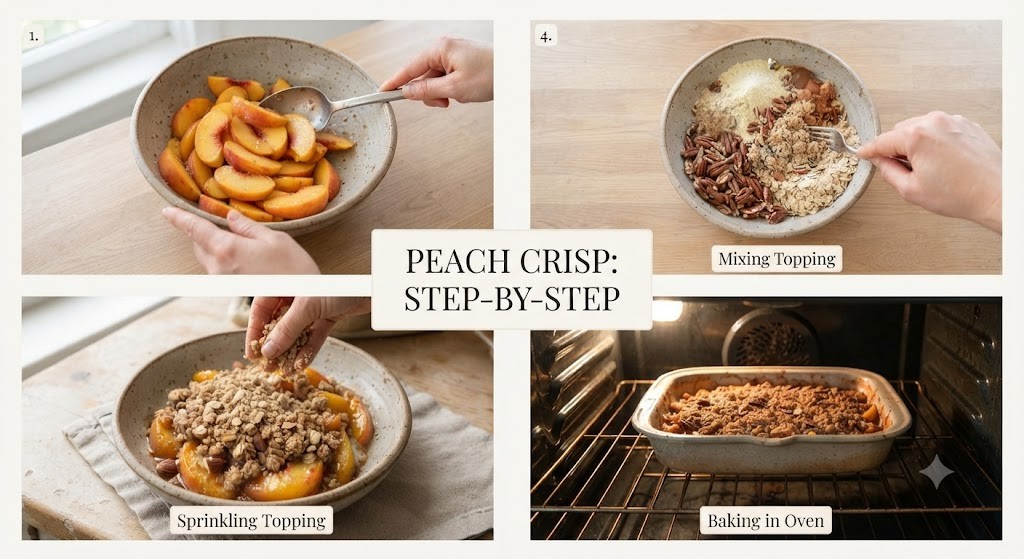
Step 1: Prep the peaches. Preheat your oven to 375°F. Slice your peaches into even wedges — no need to peel them, since the skins soften completely during baking and add a bit of extra fiber and color. Place the slices in a large mixing bowl.
Step 2: Build the filling. Add the maple syrup, lemon juice, cornstarch, cinnamon, and nutmeg to the peaches, and toss gently until every slice is evenly coated. You’ll notice the mixture starts to look glossy almost immediately as the juices begin releasing and the cornstarch starts to hydrate. Transfer the mixture into a baking dish, spreading it into an even layer.
Step 3: Make the topping. In a separate bowl, combine the oats, almond flour, chopped nuts, cinnamon, and salt. Pour in the melted coconut oil and maple syrup, then use your fingers to work everything together. The mixture should smell warm and toasty even before it hits the oven, thanks to the cinnamon and nuts, and should look like coarse, clumpy crumbles rather than a smooth paste.
Step 4: Assemble. Scatter the topping evenly over the peach filling, breaking up any large clumps but leaving some texture — those uneven clusters are what create the best crispy bits once baked.
Step 5: Bake. Place the dish in the oven and bake for 35 to 40 minutes. Around the 20-minute mark, you’ll start to smell warm cinnamon and caramelizing fruit drifting through your kitchen, and you’ll hear the filling begin to bubble gently at the edges of the dish. By the last 10 minutes, the topping should shift from pale and matte to a deep golden brown, and the bubbling should become more visible across the surface, a sign the filling has thickened properly.
Step 6: Check for doneness. The crisp is ready when the topping is golden brown and the fruit filling is bubbling thickly around the edges, not just at the surface. If the topping is browning too quickly before the filling has thickened, loosely tent the dish with foil for the remaining bake time.
Plating & Final Presentation
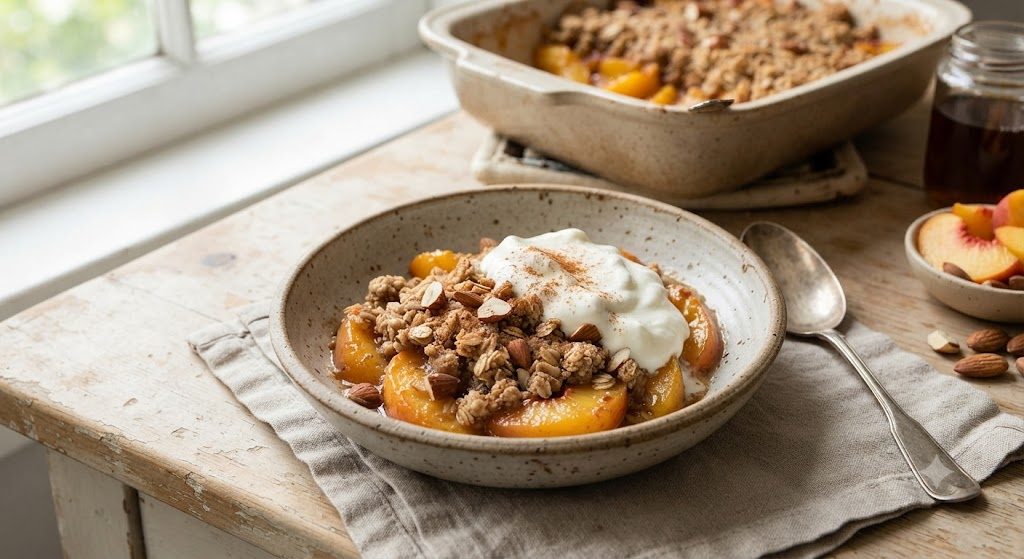
Let the crisp rest for at least 10 minutes after baking — this isn’t optional. That resting period allows the thickened juices to set slightly, so each serving holds its shape instead of spreading into a puddle. Spoon warm portions into shallow bowls, letting some of that glossy peach filling pool around the edges. A dollop of plain Greek yogurt on top adds a cool, tangy contrast to the warm spiced fruit and boosts the protein content of the dish even further. A light dusting of extra cinnamon or a few extra toasted nuts scattered on top finishes it beautifully.
Frequently Asked Questions
Can I use frozen peaches? Yes. Thaw them first and drain any excess liquid, then increase the cornstarch slightly, since frozen fruit tends to release more juice than fresh.
Can I make this nut-free? Swap the almond flour for additional oats and omit the chopped nuts, or replace them with pumpkin seeds for crunch.
Is this recipe gluten-free? Yes, as long as you use certified gluten-free oats, since oats are often processed in facilities that handle wheat.
Can I reduce the sugar further? Yes — ripe, in-season peaches are naturally sweet enough that you can reduce or omit the maple syrup in the filling entirely, adjusting to taste.
How should I store leftovers? Store covered in the fridge for up to 4 days. Reheat individual portions in the oven or toaster oven to help the topping regain some crispness.
Final Nutrition Facts Table
Per serving (recipe makes about 8 servings):
| Nutrient | Amount |
|---|---|
| Calories | 210 |
| Protein | 4g |
| Carbohydrates | 27g |
| Fat | 11g |
This version delivers real fiber from the oats and peaches, healthy fats from the nuts and coconut oil, and a meaningfully lower sugar load than a traditional crisp — all while still tasting like the warm, comforting dessert it’s meant to be.