
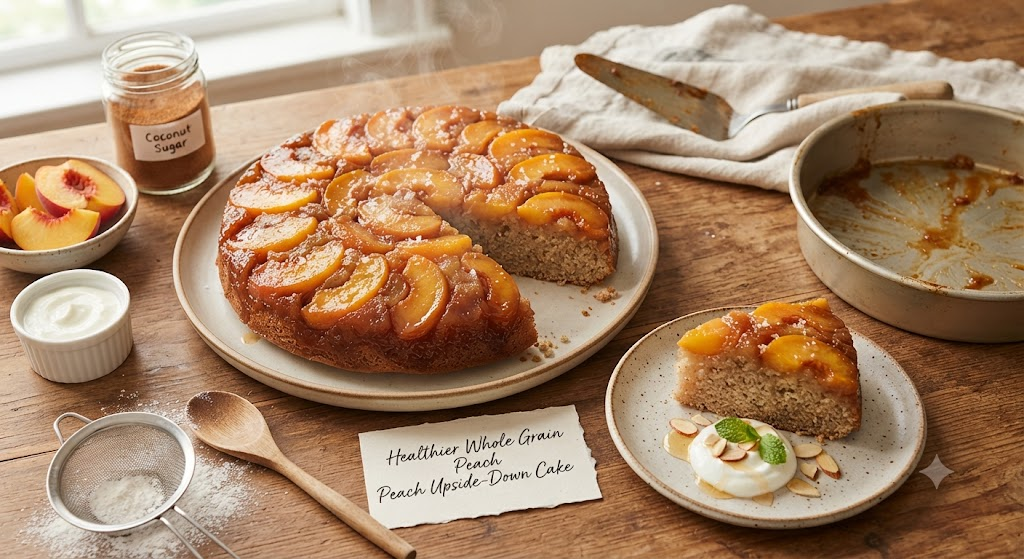
There’s a particular hush that falls over a kitchen in the seconds after you flip a cake pan — that suspended moment between “did it work” and the soft, syrupy thud of caramelized peaches releasing onto the plate below. It’s one of the most theatrical moments in home baking, and this version delivers all of that drama with a meaningfully lighter nutritional profile than the classic.
The Story & Nutritional Philosophy
At The Healthy Plate Lab, we don’t believe dessert needs to be exiled from a health-conscious kitchen — we believe it needs to be re-engineered. Traditional upside-down cakes lean heavily on refined white sugar, saturated fat, and enriched white flour, three ingredients that contribute richness but not much nutritional substance. Our approach was to identify exactly where those ingredients were doing structural or flavor work, and swap each one for something that performs the same job with a better nutritional return.
This is a reduced-sugar, whole-grain version of the classic. We cut the traditional sugar load by roughly 35%, relying on the natural sugars in ripe peaches to fill the gap, since fruit sugar arrives bundled with fiber that moderates its absorption. We replaced a portion of the all-purpose flour with white whole wheat flour, which contributes fiber and micronutrients like magnesium and B vitamins without the coarse, dense texture that whole wheat flour sometimes brings to delicate cakes. And we swapped half the butter for Greek yogurt, a technique that reduces saturated fat while actually improving moisture retention and adding a meaningful protein boost — roughly 3 extra grams per slice compared to a traditional recipe.
None of these swaps are about deprivation. They’re about efficiency: making sure every gram of sugar and fat in this cake is earning its place through flavor and texture, not just habit.
Ingredients & Nutritional Benefits
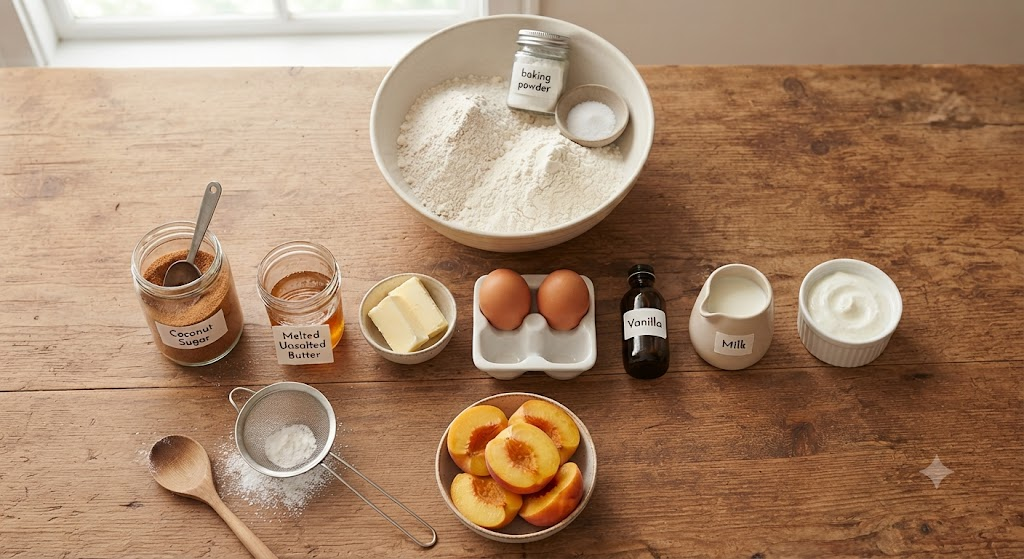
For the topping:
- 3 tbsp unsalted butter, melted — carries caramelization, small but intentional fat allowance
- 1/3 cup coconut sugar — lower glycemic index than white sugar, subtle caramel note
- 3 ripe peaches, sliced into half-moons — natural sweetness, vitamin C, fiber
For the batter:
- 1 cup white whole wheat flour — fiber, magnesium, B vitamins
- 1/2 cup all-purpose flour — structure and tenderness
- 1 1/2 tsp baking powder — leavening
- 1/4 tsp salt — flavor balance
- 1/3 cup plain Greek yogurt — protein boost, moisture, reduced saturated fat
- 3 tbsp unsalted butter, softened — richness and tenderness
- 1/2 cup coconut sugar — sweetness with a lower glycemic impact
- 2 large eggs — protein, structure, emulsification
- 1 tsp vanilla extract — aromatic depth
- 1/3 cup milk of choice — moisture, thins the batter to proper consistency
Chef’s Prep Secrets & Tips
The single most important variable in this cake is peach ripeness — again. A peach that’s slightly underripe will hold its shape beautifully during baking but taste tart and starchy once flipped; a peach that’s overripe will collapse into mush. You’re looking for peaches that are fragrant and yield gently, but still slice cleanly without falling apart.
Our caramelization tip: pour the melted butter and coconut sugar directly into the cake pan and arrange the peach slices on top before baking, rather than pre-cooking the topping on the stovetop. The oven’s steady, even heat caramelizes the sugar slowly and evenly, which produces a more uniform amber color across the entire topping instead of hot spots that can turn bitter.
Pat your peach slices dry with a paper towel before arranging them in the pan. Excess surface moisture dilutes the caramel layer and can result in a slightly soggy, rather than glossy, finished topping.
When it’s time to flip the cake, do it while the pan is still warm, not fully cooled — as the caramel cools, it hardens and can stick stubbornly to the pan, making a clean release far more difficult.
Step-by-Step Culinary Method
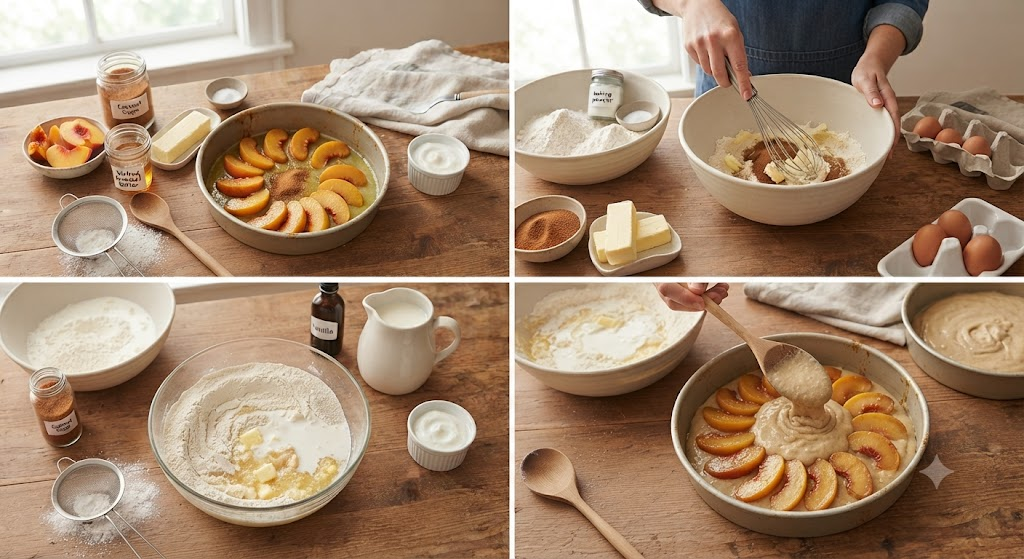
This cake comes together in two distinct components — the caramelized fruit base and the tender batter — that only meet in the oven, which is part of what makes the final flip so satisfying.
Step 1: Build the caramel base. Preheat your oven to 350°F (175°C). Pour the melted butter into a well-greased 9-inch round cake pan, tilting to coat the bottom evenly. Sprinkle the coconut sugar over the butter in an even layer — you’ll notice it immediately begins to look slightly damp and glossy as it absorbs the fat.
Step 2: Arrange the peaches. Lay the peach slices in a circular, slightly overlapping pattern over the sugar layer, starting from the outer edge and working inward. This isn’t just for appearance; even coverage ensures every slice caramelizes at the same rate, so no single piece burns while others stay pale.
Step 3: Cream the butter and sugar. In a separate bowl, beat the softened butter and remaining coconut sugar together until the mixture turns noticeably lighter in color and slightly fluffy in texture, about 2–3 minutes. This step incorporates air into the batter, which is essential for a tender, well-risen crumb rather than a dense one.
Step 4: Add wet ingredients. Beat in the eggs one at a time, followed by the Greek yogurt and vanilla extract. The batter will look slightly curdled for a moment as the yogurt is incorporated — that’s normal, and it smooths out as you continue mixing.
Step 5: Fold in the dry ingredients. In a separate bowl, whisk together both flours, baking powder, and salt. Add this dry mixture to the wet ingredients in three additions, alternating with the milk, beginning and ending with the flour. Mix just until no streaks of flour remain — overmixing at this stage develops gluten and can make the finished cake tough rather than tender.
Step 6: Assemble and bake. Gently spoon the batter over the arranged peaches, spreading it evenly to the edges of the pan without disturbing the fruit layer beneath. Bake for 35–40 minutes, until the top is golden and a toothpick inserted into the center comes out clean. Around the 30-minute mark, you’ll notice the kitchen filling with a warm, buttery, caramel-forward aroma layered with the faint floral sweetness of baked peaches — a strong visual and olfactory cue that the sugars in the topping have fully caramelized.
Step 7: Rest, then flip. Let the cake cool in the pan for exactly 10 minutes — no longer. Run a thin knife around the edge to loosen it, place a serving plate upside down over the pan, and invert both together in one confident motion. Lift the pan away slowly; if any peach slices stick, simply lift them off the pan with a spoon and place them back into position on the cake.
Plating & Final Presentation
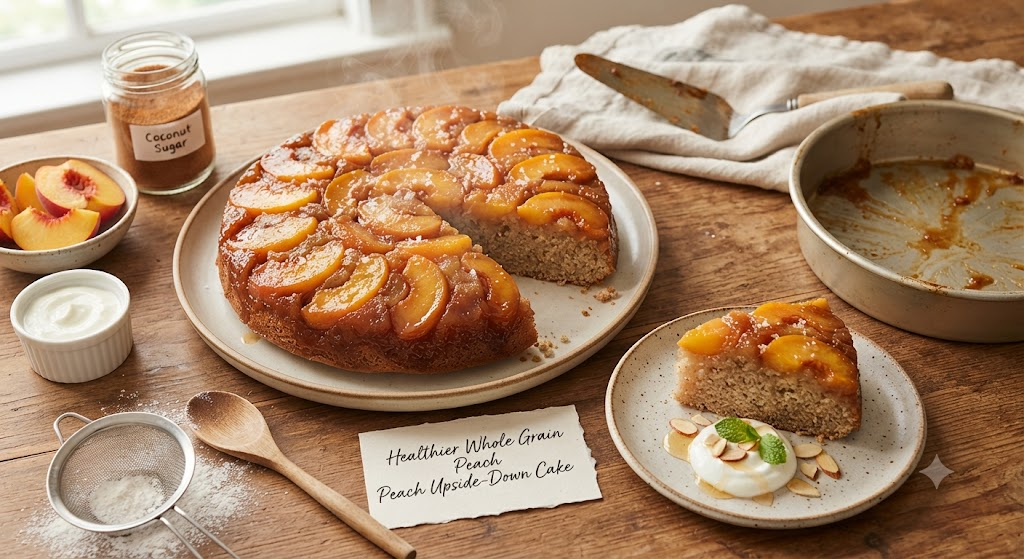
Serve the cake slightly warm, letting the glossy caramel topping catch the light. A light dusting of flaky sea salt across the surface enhances the caramel notes without adding meaningful calories. For an elevated presentation, add a small dollop of plain Greek yogurt or a light drizzle of honey alongside each slice, echoing the protein-forward theme of the batter itself. A few fresh mint leaves or a light scattering of toasted almond slivers add color and textural contrast against the deep amber peaches.
Frequently Asked Questions
Can I use canned peaches? Fresh is strongly preferred for texture and flavor, but well-drained canned peaches in juice (not syrup) can work in a pinch — pat them very dry first.
Why did my cake stick to the pan? This usually means it cooled too long before flipping, allowing the caramel to harden. Flip while the pan is still warm, and always grease it generously before starting.
Can I make this gluten-free? Yes — substitute a 1:1 gluten-free baking blend for both flours; texture will be slightly denser but still delicious.
How should I store leftovers? Keep covered at room temperature for up to 2 days, or refrigerate for up to 5 days; bring to room temperature or gently warm before serving.
Can I use a different fruit? Absolutely — pineapple, pears, or plums all caramelize beautifully using this same method.
Final Nutrition Facts Table (Per Slice, 10 Slices Total)
| Nutrient | Amount |
|---|---|
| Calories | 210 kcal |
| Protein | 5 g |
| Total Fat | 8 g |
| Carbohydrates | 30 g |
| Fiber | 2 g |
| Sugars | 17 g |
| Sodium | 140 mg |
| Vitamin C | 8% DV |