
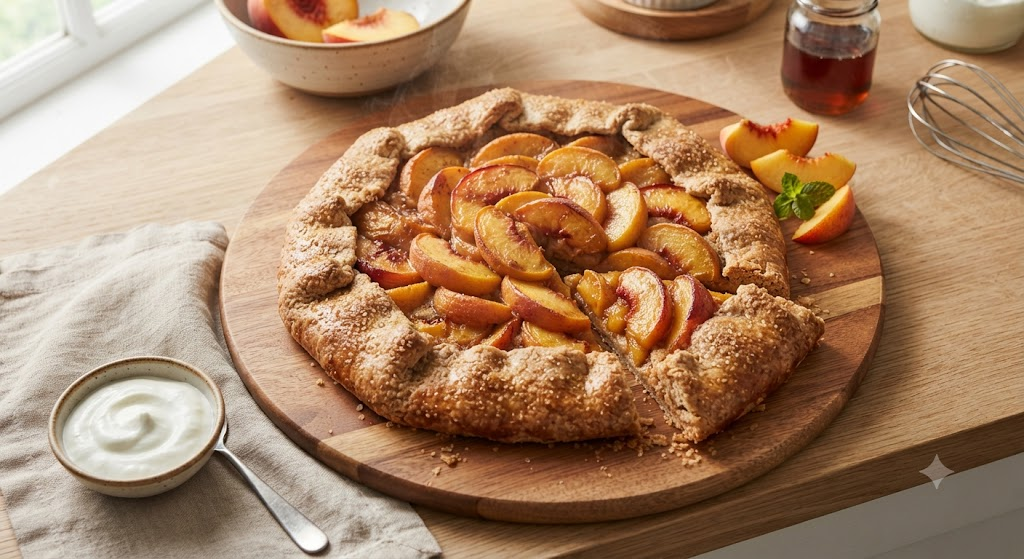
A galette is essentially a pie that gave up on perfection, and that’s exactly why it works so well for a healthier remake. There’s no fussy lattice, no fitted crust to crimp just right — you roll the dough out, pile fruit in the center, and fold the edges over rustically. That relaxed structure gives us room to rework the crust itself without anyone noticing the difference, because a slightly imperfect, free-form edge hides a multitude of textural changes.
Traditional galette dough leans almost entirely on white flour and a full stick of butter, which makes for a flaky, rich crust but not much else nutritionally. At The Healthy Plate Lab, we swapped in a portion of whole wheat pastry flour, which adds fiber without making the dough tough or dense, and we brought in a small amount of Greek yogurt alongside the butter, which lets us use noticeably less fat while keeping the dough tender and easy to work with.
For the filling, ripe peaches do most of the heavy lifting. Peaches are naturally sweet and juicy, especially in season, which means the filling needs only a modest amount of maple syrup rather than the half cup of white sugar many recipes call for. A touch of cornstarch keeps the juices from turning the crust soggy, and a scatter of almond flour under the fruit helps absorb any extra moisture while adding a bit of healthy fat and protein.
The result is a dessert that still delivers that golden, flaky, rustic crust wrapped around warm, jammy peaches — just built with a little more fiber, a little more protein, and noticeably less added sugar than the traditional version.
Ingredients & Nutritional Benefits
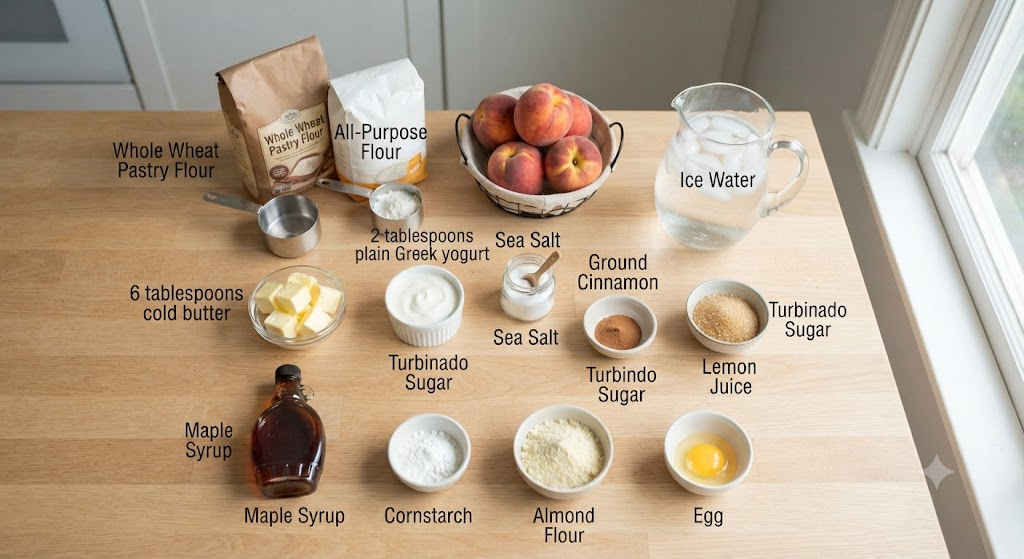
For the crust:
- ¾ cup whole wheat pastry flour — Adds fiber and a light, nutty flavor without making the dough dense.
- ½ cup all-purpose flour — Balances the whole wheat flour so the crust stays tender and easy to roll.
- ¼ teaspoon sea salt — Sharpens the overall flavor of the dough.
- 6 tablespoons cold butter, cubed — Creates the flaky layers a good galette crust depends on.
- 2 tablespoons plain 2% Greek yogurt — Our key swap, allowing less butter while keeping the dough tender and adding a small protein boost.
- 3–4 tablespoons ice water — Brings the dough together without overworking it.
For the filling:
- 4 cups sliced ripe peaches (about 4–5 medium peaches) — Naturally sweet and rich in fiber, vitamin C, and vitamin A, doing most of the sweetness work in this recipe.
- 2 tablespoons maple syrup — A modest natural sweetener that lets the peaches’ own flavor shine.
- 1 tablespoon lemon juice — Brightens the filling and balances the sweetness.
- 1 tablespoon cornstarch or arrowroot powder — Thickens the peach juices so the crust stays crisp instead of soggy.
- ½ teaspoon ground cinnamon — Adds warmth that complements the peaches.
- 2 tablespoons almond flour — Scattered under the fruit to absorb excess moisture, while adding a bit of healthy fat and protein.
To finish:
- 1 egg, beaten (for egg wash) — Gives the crust its golden, glossy finish.
- 1 tablespoon turbinado or coarse sugar — A light finishing touch for crunch and sparkle on the crust edges.
Chef’s Prep Secrets & Tips
Keep everything cold. This is the single most important rule for any laminated or flaky dough. Cold butter creates small pockets of fat that melt during baking and produce steam, which is what makes the crust flaky rather than dense. If your kitchen is warm, or the butter starts to feel soft while you’re working, pop the dough back in the fridge for 10 minutes before continuing.
Second, don’t skip the almond flour layer under the fruit. Peaches release a lot of juice as they bake, and a thin layer of almond flour absorbs that excess moisture right at the base of the filling, preventing the dreaded soggy-bottom crust that plagues so many fruit galettes.
Third, work quickly when folding the edges of the dough over the fruit. The longer the dough sits at room temperature, the softer and harder to work with it becomes. If it starts to feel too soft or sticky, a quick 5-minute stint in the fridge on the baking sheet firms it back up without disrupting your progress.
A food scale can help here for measuring the flours precisely, since scooping directly with a measuring cup tends to pack the flour down and can make the dough tougher than intended.
Step-by-Step Culinary Method
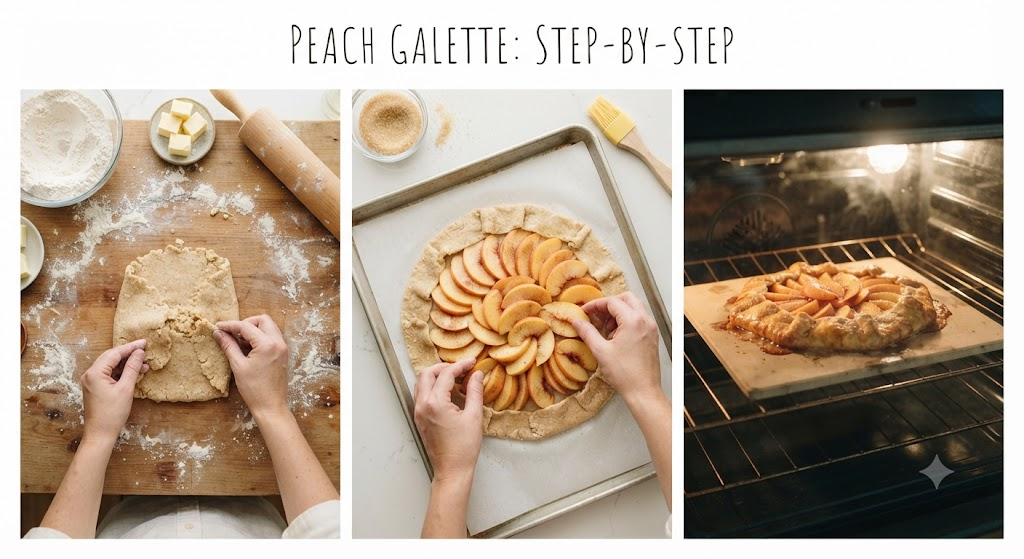
Step 1: Make the dough. In a large bowl, whisk together the whole wheat pastry flour, all-purpose flour, and salt. Add the cold, cubed butter and use your fingers or a pastry cutter to work it into the flour until the mixture resembles coarse crumbs with some pea-sized pieces of butter still visible. Stir in the Greek yogurt, then add ice water a tablespoon at a time, mixing just until the dough comes together. Shape it into a disc, wrap in plastic, and refrigerate for at least 30 minutes.
Step 2: Prep the filling. While the dough chills, slice the peaches into wedges and place them in a large bowl. Add the maple syrup, lemon juice, cornstarch, and cinnamon, and toss gently until every slice is evenly coated. Within a few minutes, the mixture will start to look glossy as the juices begin to release and the cornstarch hydrates.
Step 3: Roll out the dough. On a lightly floured surface, roll the chilled dough into a rough circle about 12 inches in diameter and roughly ⅛ inch thick. Don’t worry about making it perfectly round — the rustic, uneven edge is part of the charm. Transfer the dough to a parchment-lined baking sheet.
Step 4: Assemble. Sprinkle the almond flour evenly across the center of the dough, leaving a 2-inch border uncovered. Arrange the peach slices on top in a slightly overlapping pattern, then fold the uncovered edges of the dough up and over the fruit, pleating loosely as you go around the circle. The center will remain open, with the peaches visible.
Step 5: Bake. Preheat your oven to 400°F while you brush the folded edges of the dough with the beaten egg and sprinkle with the turbinado sugar. Bake for 35 to 40 minutes. Around the 20-minute mark, you’ll start to smell warm, caramelizing fruit and buttery pastry filling your kitchen, and you’ll notice the exposed peach juices beginning to bubble gently in the center. By the final 10 minutes, the crust should deepen from pale to a rich golden brown, and the fruit should look glossy and slightly slumped as the juices thicken.
Step 6: Check for doneness. The galette is ready when the crust is deeply golden brown all the way around, not just at the tips of the folds, and the filling is visibly bubbling and thickened rather than watery. If the crust is browning too quickly before the filling thickens, loosely tent the edges with foil for the remaining bake time.
Plating & Final Presentation
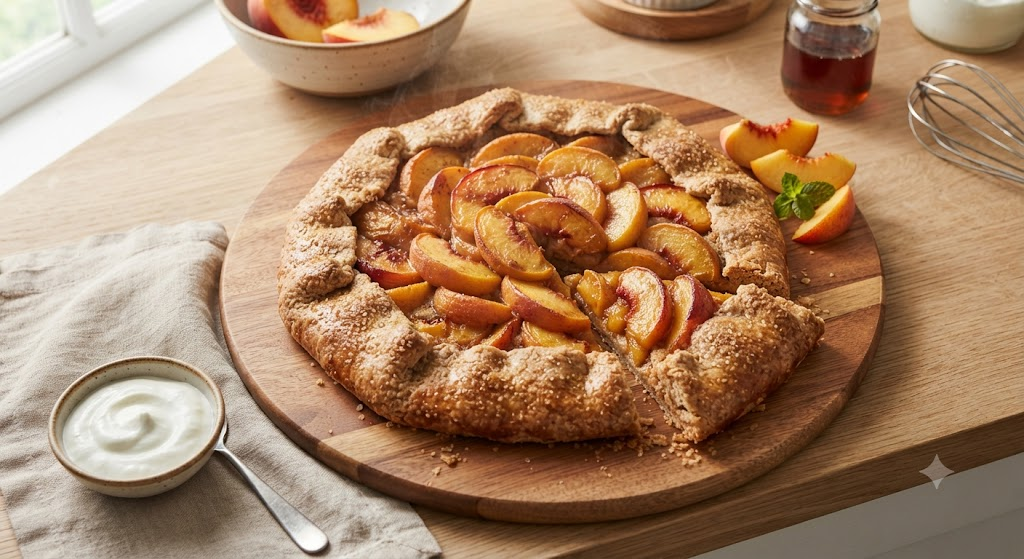
Let the galette cool on the baking sheet for at least 15 minutes before slicing — this rest period allows the thickened peach juices to set slightly, so each slice holds together instead of sliding apart. Transfer the whole galette to a wooden board or platter for a rustic, farmhouse-style presentation. Slice into wedges and serve warm, with a dollop of Greek yogurt melting slightly against the warm fruit in place of ice cream. A light dusting of extra cinnamon over the top adds a final touch of color and warmth.
Frequently Asked Questions
Can I use frozen peaches? Yes, though they release more liquid than fresh, so increase the cornstarch to 1 ½ tablespoons and don’t fully thaw them before slicing.
Can I make the dough ahead of time? Yes — the dough can be made up to 2 days in advance and kept wrapped in the fridge, or frozen for up to a month.
Why is my crust soggy on the bottom? This usually means the almond flour layer was skipped or the filling wasn’t thickened enough with cornstarch before assembling.
Can I make this dairy-free? Substitute a plant-based butter and a dairy-free yogurt; the texture will be very similar.
How should I store leftovers? Store loosely covered at room temperature for up to 2 days, or in the fridge for up to 4 days. Reheat individual slices in the oven to help the crust regain some crispness.
Final Nutrition Facts Table
Per slice (recipe makes about 8 slices):
| Nutrient | Amount |
|---|---|
| Calories | 205 |
| Protein | 4g |
| Carbohydrates | 26g |
| Fat | 9g |
This version delivers real fiber from the whole wheat crust and peaches, a bit of extra protein and healthy fat from the almond flour and Greek yogurt, and noticeably less added sugar than a traditional galette — while still delivering that flaky, golden crust wrapped around warm, jammy fruit.