
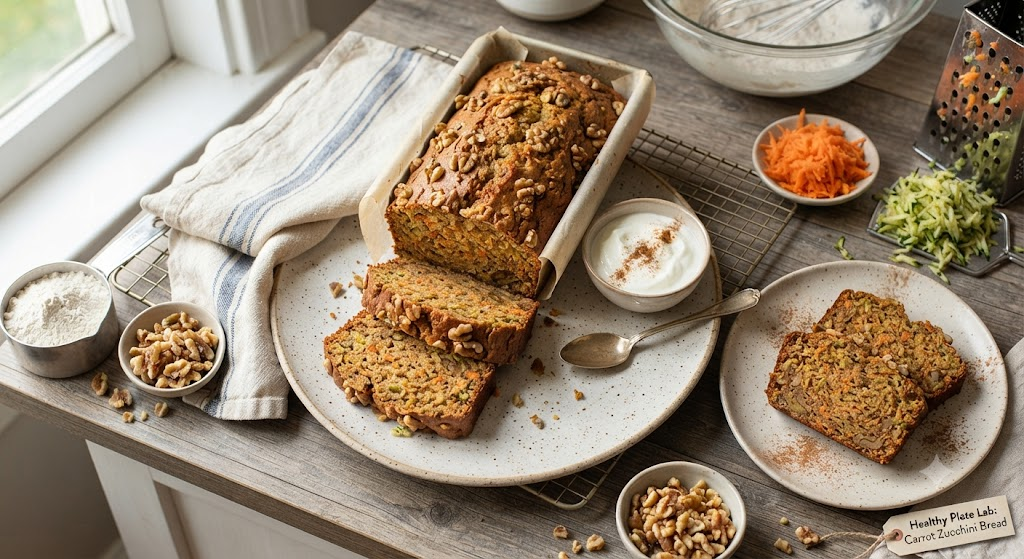
There’s a particular sound that gives away a great carrot zucchini bread before it’s even sliced — a soft, dense crackle across the top crust as it cools, followed by the faint squeak of moist, shredded vegetables compressing gently beneath a knife. Combined with the warm scent of cinnamon and toasted walnuts, it’s the kind of loaf that smells like a bakery even though it’s quietly doing the nutritional work of a vegetable side dish.
The Story & Nutritional Philosophy
At The Healthy Plate Lab, we’re especially fond of double-vegetable bakes like this one, because they demonstrate a principle we return to often: stacking small, functional swaps produces a much bigger nutritional shift than any single change could on its own. This loaf combines two of our favorite “invisible vegetable” ingredients — shredded carrot and shredded zucchini — each contributing moisture, fiber, and micronutrients without asking the eater to notice or compromise on flavor.
This is a fiber-boosted, reduced-sugar recipe. Carrots contribute beta-carotene, a provitamin A compound your body converts as needed, along with a subtle natural sweetness that let us reduce the added sugar in this loaf by about 30% compared to a standard quick bread. Zucchini, true to its role in our other recipes, adds moisture and volume with almost no caloric cost, while its high water content means we can use noticeably less oil than a traditional carrot cake or zucchini bread recipe made on its own. We also swap a portion of the oil for unsweetened applesauce, which adds moisture through natural pectin rather than pure fat, and we use white whole wheat flour to bring fiber and B vitamins into a category of baked good that’s typically nutritionally thin.
The result is a loaf that reads as rich, moist, and lightly spiced — closer to a well-loved carrot cake than a virtuous vegetable bread — while delivering meaningfully more fiber, vitamin A, and potassium per slice than either vegetable would provide baked on its own.
Ingredients & Nutritional Benefits
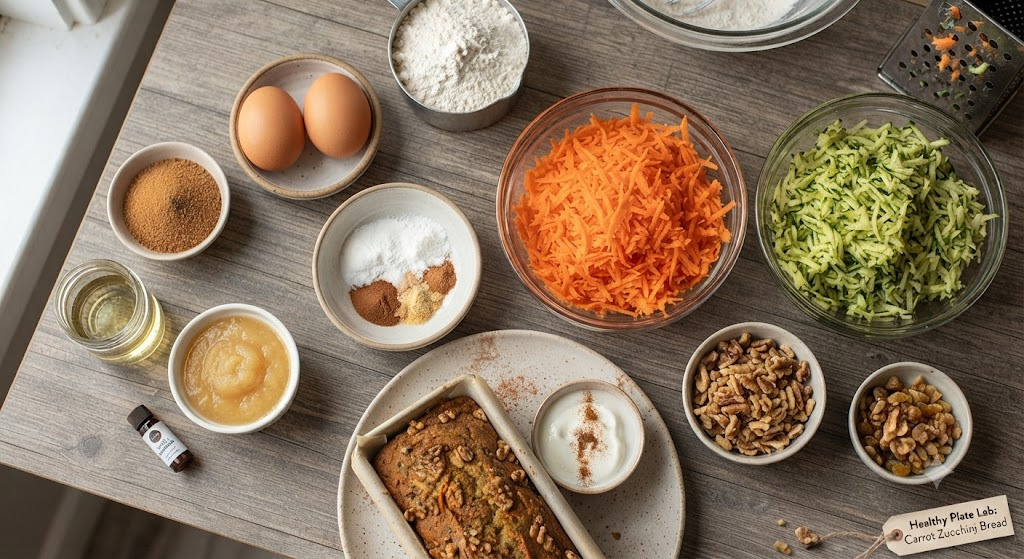
- 1 cup shredded carrot — beta-carotene, natural sweetness, fiber
- 1 cup shredded zucchini, squeezed dry — moisture, potassium, vitamin C, low-calorie volume
- 1 3/4 cups white whole wheat flour — fiber, magnesium, B vitamins
- 1 tsp baking soda — leavening
- 1/2 tsp baking powder — additional lift
- 1 1/2 tsp cinnamon — warmth, natural sweetness perception
- 1/4 tsp ground ginger — aromatic depth
- 1/2 tsp salt — flavor balance
- 2 large eggs — protein, structure
- 1/2 cup coconut sugar — lower glycemic sweetness
- 1/4 cup neutral oil (avocado or light olive oil) — moisture, healthy fat
- 1/4 cup unsweetened applesauce — moisture with reduced fat
- 1 tsp vanilla extract — aromatic depth
- 1/3 cup chopped walnuts — omega-3 fatty acids, satisfying crunch
- 1/4 cup raisins (optional) — additional natural sweetness and chew
Chef’s Prep Secrets & Tips
The most important technical step in this recipe is moisture control, and it applies differently to each vegetable. Zucchini needs to be actively wrung out in a kitchen towel, exactly as in our other zucchini-based recipes, since its water content is high enough to throw off the batter’s ratio if left unaddressed. Carrot, by contrast, holds much less water and should be left as-is, since a small amount of its natural moisture is actually welcome in the batter.
Our shredding tip: use the large holes of a box grater for both vegetables rather than a food processor, which tends to shred too finely and can make the loaf denser than intended. Coarser shreds hold their structure through baking, creating small, pleasant pockets of tenderness rather than disappearing entirely into the crumb.
Toast the walnuts in a dry skillet for 3–4 minutes before folding them into the batter. This single step meaningfully deepens their flavor, since raw walnuts folded directly into a moist batter can taste flat and slightly bitter by comparison.
Step-by-Step Culinary Method
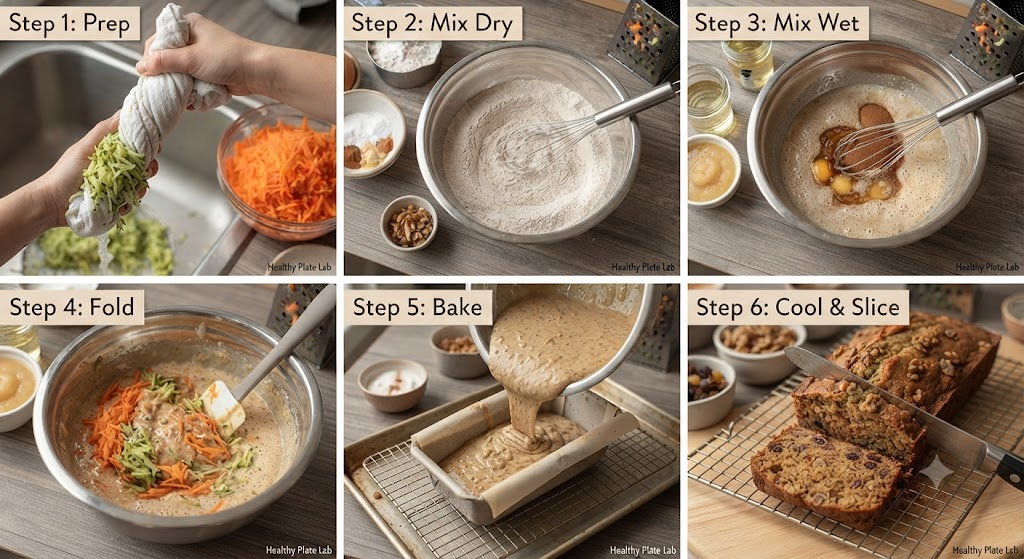
This bread comes together in a straightforward two-bowl method, but a few transitions determine whether the finished loaf is moist and tender or dense and gummy.
Step 1: Prep the vegetables. Shred the carrot and zucchini separately. Wring the zucchini out thoroughly in a clean kitchen towel until it feels noticeably lighter and drier in your hand; leave the carrot as-is.
Step 2: Preheat and prep the pan. Preheat your oven to 350°F (175°C). Grease a 9×5-inch loaf pan and line it with parchment paper, leaving a slight overhang on the long sides for easy removal.
Step 3: Whisk the dry ingredients. In a medium bowl, whisk together the flour, baking soda, baking powder, cinnamon, ginger, and salt, making sure the leavening agents are evenly distributed throughout the flour.
Step 4: Combine the wet ingredients. In a large bowl, whisk the eggs and coconut sugar together until slightly lightened in color, about a minute. Whisk in the oil, applesauce, and vanilla extract until smooth.
Step 5: Fold in the vegetables. Stir the shredded carrot and squeezed zucchini into the wet mixture. The batter will take on a flecked orange-green appearance and a noticeably thicker, more textured consistency than a standard cake batter.
Step 6: Combine wet and dry. Add the dry ingredients to the wet mixture in two additions, folding gently just until no streaks of flour remain. Overmixing at this stage develops gluten and can make the finished loaf tough rather than tender. Fold in the toasted walnuts and raisins if using, reserving a small handful of walnuts to press onto the top of the loaf.
Step 7: Bake. Pour the batter into the prepared pan, smoothing the top, and scatter the reserved walnuts over the surface. Bake for 50–55 minutes. Around the 40-minute mark, your kitchen should fill with a warm, spiced aroma, and the top of the loaf will develop a light golden-brown crackle — a visual sign the sugars are setting properly. The bread is done when a toothpick inserted into the center comes out with just a few moist crumbs, not wet batter.
Step 8: Cool completely before slicing. Let the loaf cool in the pan for 15 minutes, then lift it out using the parchment overhang and cool completely on a wire rack, at least an hour. Slicing too early compresses the still-steaming crumb rather than allowing it to slice cleanly.
Plating & Final Presentation
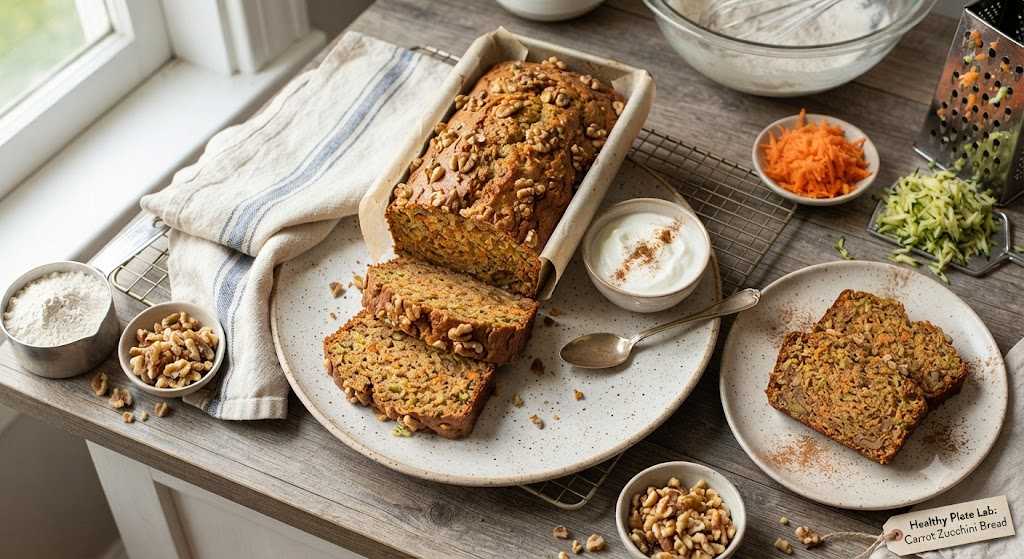
Slice the cooled loaf into thick, even pieces to show off the moist, flecked crumb studded with walnuts and the occasional golden raisin. For an elevated presentation, serve slightly warmed with a light smear of whipped cream cheese or a dollop of Greek yogurt on the side, echoing the traditional carrot cake pairing while keeping the protein content higher than a standard frosting would. A light dusting of cinnamon across the plate finishes the presentation cleanly.
Frequently Asked Questions
Do I need to peel the carrot or zucchini? Peeling the carrot is recommended for texture, but the zucchini skin can stay on — it’s undetectable once shredded and baked, and it retains extra fiber.
Can I freeze this bread? Yes, it freezes very well. Wrap sliced or whole loaf tightly in plastic wrap and foil; it keeps for up to 3 months.
Why is my loaf dense or gummy? This is almost always due to excess zucchini moisture that wasn’t wrung out thoroughly, or overmixing the batter once the flour is added.
Can I make this gluten-free? Yes — substitute a 1:1 gluten-free baking blend for the whole wheat flour; the texture will remain moist.
Can I skip the nuts? Absolutely — simply omit them or substitute sunflower or pumpkin seeds for a similar crunch without tree nuts.
Final Nutrition Facts Table (Per Slice, 10 Slices Total)
| Nutrient | Amount |
|---|---|
| Calories | 190 kcal |
| Protein | 4 g |
| Total Fat | 8 g |
| Carbohydrates | 27 g |
| Fiber | 3 g |
| Sugars | 13 g |
| Sodium | 200 mg |
| Vitamin A | 30% DV |