
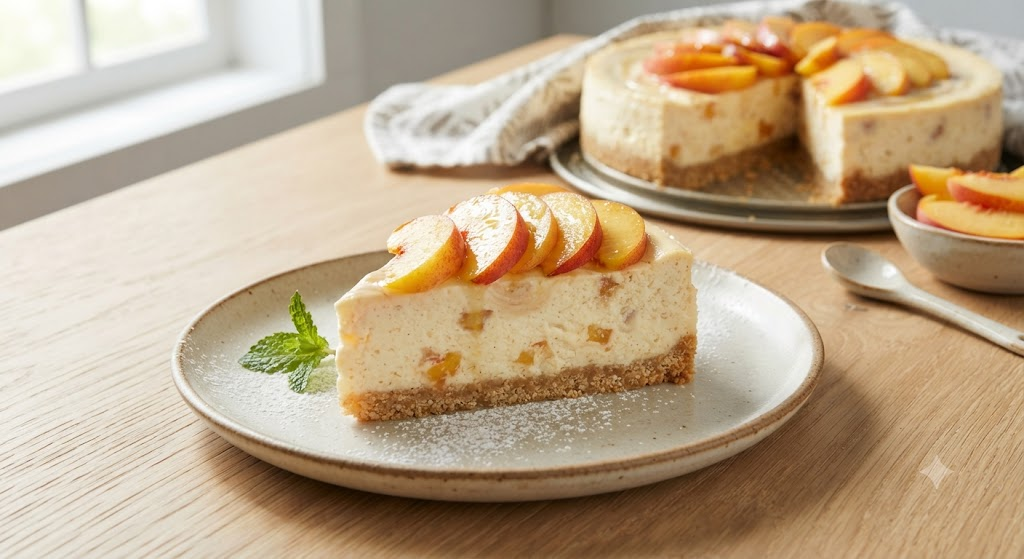
The Story & Nutritional Philosophy
Cheesecake is, by most traditional standards, one of the more indulgent desserts in the baking world — a full block or more of cream cheese, a cup of sugar, heavy cream, and a butter-laden graham cracker crust, often landing well over 450 calories per slice before any fruit topping is added. At The Healthy Plate Lab, we wanted to prove that a genuinely creamy, rich-tasting cheesecake doesn’t require that level of excess, and that fresh peaches can do real nutritional and flavor work rather than just sitting decoratively on top.
The base of any cheesecake’s nutritional profile comes down to the filling, and that’s where we focused our biggest swap. Instead of relying entirely on full-fat cream cheese, we use a blend of reduced-fat cream cheese and Greek yogurt, which cuts saturated fat substantially while adding a meaningful protein boost that traditional cheesecake simply doesn’t offer. Greek yogurt also brings a natural tang that pairs beautifully with both the cream cheese base and the sweet peaches, creating a more balanced, less heavy flavor profile than an all-cream-cheese filling.
Fresh peaches contribute real nutritional value here, not just visual appeal. We fold a portion of roasted peaches directly into the filling and layer fresh slices on top, allowing the fruit’s natural fiber, vitamin C, and vitamin A to factor meaningfully into the dessert rather than serving as a token garnish. For sweetness, we use a modest amount of coconut sugar in both the crust and filling, letting the peaches’ own sweetness carry much of the flavor load. The crust gets its own upgrade too — a blend of almond flour and a smaller portion of crushed graham crackers, which reduces refined carbohydrates while adding healthy fat and protein to the foundation of the dessert. The result is a cheesecake that’s higher in protein, lower in added sugar and saturated fat, and genuinely creamy enough to satisfy a true cheesecake craving — proof that this beloved indulgence can fit comfortably into a more nutrient-forward approach to dessert. This recipe is easily made gluten-free with a gluten-free graham cracker swap.
Ingredients & Nutritional Benefits
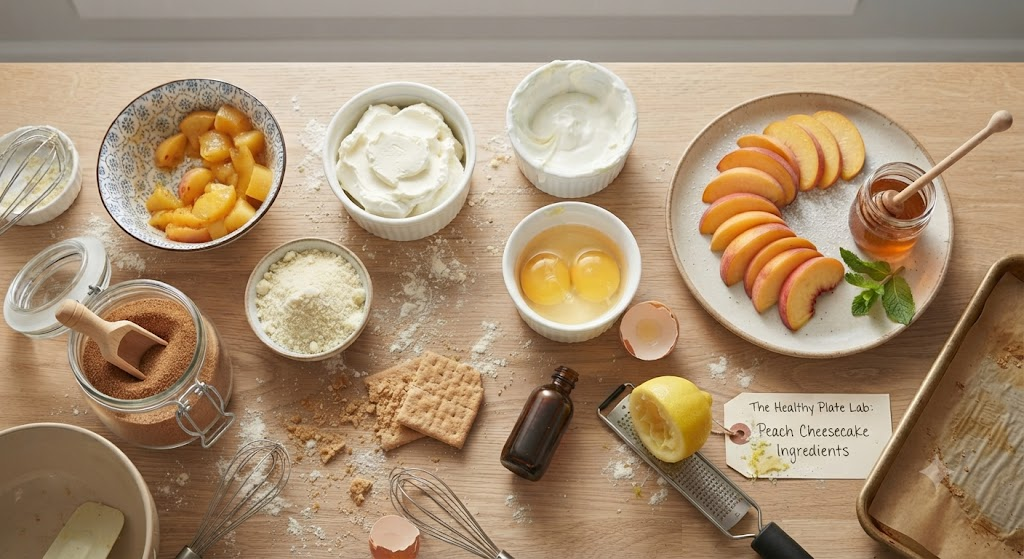
For the Lightened Crust:
- 3/4 cup almond flour — Adds healthy fats and protein, reducing reliance on refined crackers alone.
- 1/2 cup crushed graham crackers (gluten-free if needed) — Provides classic crust flavor and texture in a measured amount.
- 2 tablespoons coconut sugar — Adds light sweetness with a lower glycemic impact than refined white sugar.
- 3 tablespoons melted coconut oil or unsalted butter — Binds the crust using significantly less fat than a traditional all-butter version.
For the Protein-Rich Filling:
- 12 oz reduced-fat cream cheese, softened — Provides the classic tangy richness with meaningfully less saturated fat than full-fat versions.
- 1 cup plain Greek yogurt — Adds creaminess, tang, and a substantial protein boost.
- 1/3 cup coconut sugar — Sweetens the filling without relying on a full cup of refined sugar.
- 2 large eggs — Provides structure and additional protein.
- 1 teaspoon pure vanilla extract — Adds warm, aromatic depth.
- 1 tablespoon fresh lemon juice — Brightens the filling and balances the richness of the cream cheese.
- 1 cup fresh peaches, peeled, diced, and lightly roasted — Folds real fruit flavor, fiber, and antioxidants directly into the filling.
For the Fresh Peach Topping:
- 2 cups fresh peaches, peeled and thinly sliced — Provides a vibrant, naturally sweet finishing layer.
- 1 tablespoon honey, warmed (for glazing) — Adds a light, glossy sheen with minimal added sugar.
This filling structure means a meaningful portion of every slice’s protein and fiber comes from genuinely functional ingredients, not just flavor additions.
Chef’s Prep Secrets & Tips
The most important rule in any cheesecake recipe, healthy or not, is using fully room-temperature cream cheese, Greek yogurt, and eggs. Cold ingredients refuse to blend smoothly, leaving behind small lumps that bake into a grainy, uneven texture rather than the silky-smooth filling you’re after. Set everything out at least an hour before you start mixing.
Roasting a portion of your peaches before folding them into the filling, rather than using them entirely raw, concentrates their flavor and removes excess moisture that could otherwise thin out the batter. Toss diced peaches with a touch of coconut sugar and roast at 400°F for 12-15 minutes until softened and lightly caramelized at the edges, then let them cool completely before folding in.
A water bath isn’t strictly required for this lightened filling the way it is for a dense, all-cream-cheese version, but baking at a lower, gentler temperature is still essential to prevent cracking. Resist the urge to raise the oven temperature to speed things up — slow and steady baking is what keeps the surface smooth.
Finally, patience after baking matters more than almost any other step. Cheesecake needs a full, undisturbed chill in the refrigerator — ideally overnight — to set properly. Slicing too early, even if the cheesecake looks fully baked, will result in a softer, less sliceable texture.
Step-by-Step Culinary Method
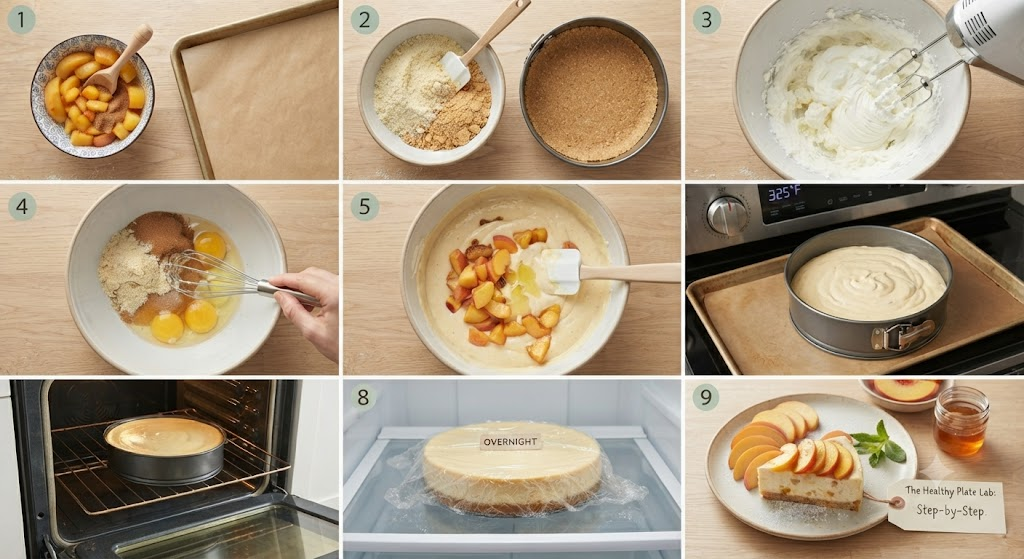
Step 1: Prepare and Roast the Peaches. Preheat your oven to 400°F (200°C). Toss the diced peaches for the filling with a small pinch of coconut sugar and spread on a parchment-lined baking sheet. Roast for 12-15 minutes, until softened and lightly golden at the edges. You’ll notice a warm, caramelized aroma rising from the pan as the natural sugars in the peaches begin to concentrate. Remove and let cool completely while you prepare the crust. Reduce the oven temperature to 325°F (165°C).
Step 2: Build and Bake the Crust. In a medium bowl, combine the almond flour, crushed graham crackers, and coconut sugar. Pour in the melted coconut oil or butter and stir until the mixture resembles damp, evenly moistened sand. Press firmly and evenly into the bottom of a 9-inch springform pan, using the bottom of a measuring cup to compact it into a tight, uniform layer. Bake for 8-10 minutes, until just lightly golden and fragrant, then remove and let cool while you prepare the filling.
Step 3: Beat the Cream Cheese and Yogurt. In a large bowl, beat the softened cream cheese and Greek yogurt together with an electric mixer on medium speed for 2-3 minutes. You’ll watch the mixture transform from a slightly lumpy, separated texture into a smooth, fully homogenous, pale cream — scrape down the sides of the bowl at least once to ensure no hidden lumps remain.
Step 4: Add Sugar and Eggs. Add the coconut sugar and beat until fully incorporated, about 1 minute, noticing the mixture lighten slightly in color and texture. Add the eggs one at a time, beating on low speed just until each is incorporated before adding the next — overbeating at this stage can incorporate too much air, which contributes to cracking during baking.
Step 5: Add Flavor and Fold in Peaches. Beat in the vanilla extract and lemon juice until just combined. Gently fold in the cooled roasted peaches by hand with a spatula, using slow, broad strokes. You’ll see small golden-orange flecks of fruit distribute throughout the pale, creamy batter, with streaks of concentrated peach juice swirling gently into the mixture as you fold.
Step 6: Bake the Cheesecake. Pour the filling over the cooled crust, smoothing the top with a spatula. Bake at 325°F for 45-55 minutes. Around the 35-minute mark, the edges will appear set and slightly puffed while the center still has a gentle, subtle jiggle when you nudge the pan — this is exactly what you want, since the center will continue to set as it cools. The top should look matte and pale golden, without any deep browning.
Step 7: Cool Gradually. Turn off the oven, crack the door open slightly, and let the cheesecake sit inside for 1 hour. This gradual temperature drop is the single most effective way to prevent the surface from cracking, since a sudden change in temperature causes the delicate protein structure to contract too quickly.
Step 8: Chill Thoroughly. Remove the cheesecake from the oven and let it cool completely to room temperature on the counter, about 1 hour. Cover and refrigerate for at least 6 hours, though overnight is ideal — you’ll notice the texture firm up significantly during this time, transitioning from a soft, custard-like consistency to a properly dense, sliceable cheesecake texture.
Step 9: Top with Fresh Peaches. Just before serving, arrange the fresh peach slices in an overlapping pattern across the top of the chilled cheesecake. Brush lightly with the warmed honey for a glossy, polished finish that catches the light beautifully.
Plating & Final Presentation
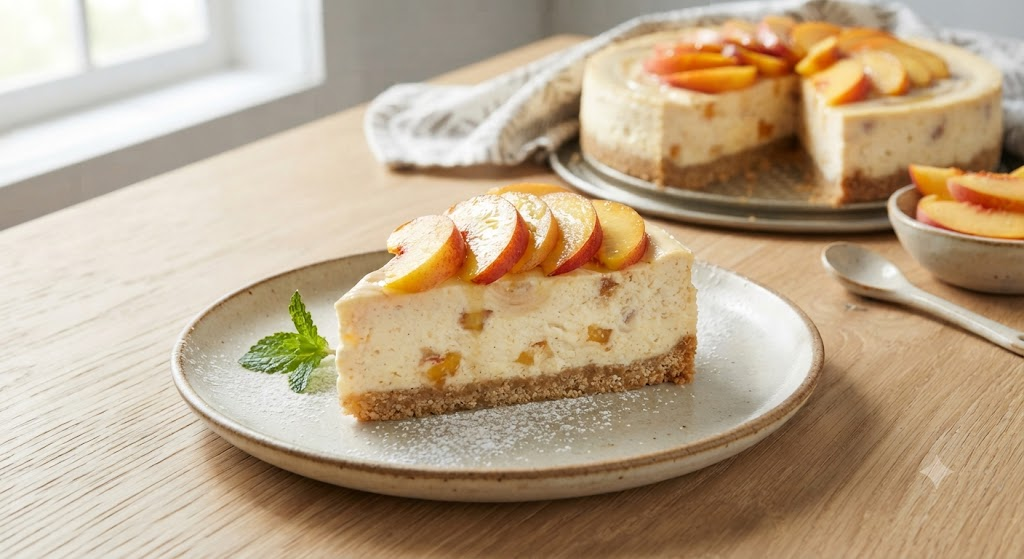
Carefully release the springform pan and transfer the cheesecake to a flat serving platter. The fanned, glossy peach slices across the top create natural visual movement, while the pale golden crust peeking out from beneath the creamy white filling adds contrast. Slice with a sharp knife dipped in warm water between cuts for clean, bakery-style slices, and serve each piece with a small extra peach slice or a sprig of mint tucked alongside for a fresh, finished look.
Frequently Asked Questions
Can I use frozen peaches instead of fresh? Yes for the roasted portion in the filling, thawed and well-drained first; fresh peaches are recommended for the topping for the best appearance and texture.
Can I make this gluten-free? Yes, simply use gluten-free graham crackers in the crust.
Why did my cheesecake crack? This is almost always from overbeating the eggs, baking at too high a temperature, or cooling too quickly — the gradual oven-door-cracked cooling step is key to preventing this.
How far in advance can I make this? This cheesecake actually improves with a full overnight chill, making it an ideal make-ahead dessert for gatherings up to 2 days in advance.
Can I make individual mini cheesecakes instead? Yes, divide the crust and filling among a lined muffin tin and reduce the baking time to roughly 20-22 minutes.
Final Nutrition Facts Table
Per slice (based on 12 slices total)
| Nutrient | Amount |
|---|---|
| Calories | 220 kcal |
| Total Carbohydrates | 18 g |
| Dietary Fiber | 1.5 g |
| Sugars | 12 g (vs. ~22 g in traditional recipe) |
| Net Carbs | 16.5 g |
| Protein | 8 g |
| Total Fat | 13 g |
| Saturated Fat | 6 g |
| Sodium | 180 mg |
| Vitamin C | 8% DV |
| Vitamin A | 6% DV |
Compared to a traditional peach cheesecake, this version cuts added sugar by nearly half and reduces saturated fat noticeably through the reduced-fat cream cheese and Greek yogurt swap, while more than doubling the protein content per slice — a genuinely creamy, satisfying dessert that doesn’t ask you to choose between indulgence and nutrition.